Sunday, 11 March 2012


#Someone Tell CNN


#SomeoneTellCNN has been trending in Kenya for more than 12 hours now. Well this was a demand by Kenya's ‘twittosphere’ who agree that CNN was inept and out-rightly unfair to the Kenyan nation on its reporting of the grenade explosions that occurred at Country Bus Station in downtown Nairobi in the evening of Saturday 10th March 2012 for a formal apology from CNN.


Frankly, I live in Nairobi and was less than 5 miles away from the site of the grenade explosion that CNN referred to in this erroneous ‘news scoop’ and there are two things; a fact and the other a falsehood that I’d like anyone who reads this post to appreciate.

Fact: - Three hand grenades were thrown out of a moving car that exploded and killed three instantly, another three succumbed to injuries at the Kenyatta National Hospital and 68 others sustained injuries from the explosion.
Fiction: - David McKenzie’s allusion that a wave of VIOLENCE had revisited Kenya

This is the typical case of unfair bad reporting of events that happen in Africa by international media: An obviously exaggerated and blown out of proportion account of a grenade attack that the government of Kenya is investigating and already linked to the infamous rogue Somali militia – Al Shabab. Listen folks at CNN, get it from me, KENYA IS PEACEFUL, there is no VIOLENCE as portrayed by David McKenzie yesterday. What happened was an isolated case that obviously didn’t warrant the amount of publicity that was granted by CNN. If I worked for CNN, I would have reported to you how a desperate cornered militia group attempted to disturb peace in Nairobi and how Kenya is dealing with it; how the rest of the country is largely serene despite the attacks. Or better still I would report to you the milestones that Kenyan athletes were accomplishing  in Istanbul, Turkey at the IAAF indoor games at the moment of the explosion.   


As he went ahead to deny having used the word VIOLENCE on air during the live broadcast, the banner screaming ‘VIOLENCE IN KENYA’ that accompanied it betrayed his alibi and irked the millions of Kenyans on twitter. It spoke volumes to the huge audience he was targeting. With all due respect David McKenzie and CNN succeed in unearthing the dark moments in the history of Kenya that we’ve struggled to deal with, a portrait that has cost us fortunes in economic terms and a priceless image of peace that we will forever owe our future generations. Whoever is aware of the violence that rocked Kenya in 2007/2008 after disputed elections definitely had a memory refresher that is hard to undo! 

Though Kenyans on twitter have boldly posited their dissatisfaction and demanded an apology from CNN (follow this link for a transcript http://www.youtube.com/watch?v=56VuSrYSSWE) I think an apology cannot be the ultimate. Am trying to soberly argue with whoever is responsible for editing news at CNN: could you please develop the habit of doing a lot more serious background work before you hurry to grab a 'news scoop' and make fools of yourselves.  I am not a trained journalist but I keep wondering: Why is it so difficult to be objective and truthful about what is reported about happenings in Africa? Yes, Africa has her share of challenges: poverty, bad governance, violence etc but what kills Africa most today is the bad IMAGE and bad publicity every African state has got to deal with. This out-rightly irresponsible and contemptuous trend in reporting African affairs must stop.

Come on folks, we are struggling to market Africa here. We are trying to attract investment and people for tourism. This pessimistic countenance sure makes things much harder. Stop portraying Africa as the home of EVIL, SQUALOR and all manner of negatives. Image is very integral for the African Renaissance and so as much as David MacKenzie might have offered a half hearted 136 character apology to Kenyans on twitter, the bad image he conveyed to billions of CNN audience can obviously not be reversed. The damage is done.  It will cost loads more to change the perception of the Swiss couple that was making travel arrangements to come to Kenya for holiday; to regain the confidence of the Chinese businessman who was finalising portfolio preparations and correspondence ahead of an investment meet in Kenya and of course much more to win the will of the Canadian student that was winding up preparations to travel to Kenya for a months long research.


No amount of apology on CNN can possibly cure that. 

Thursday, 23 February 2012


Listen Mr. African 'STATESMAN': Rants of a Troubled Pan-Africanist

OK listen AU, IGAD, EAC, NEPAD and all other multilateral African institutions and ‘statesmen’ who’ve perfected the art of perennially ranting and whining about ‘Western Imperialism’. I am talking as a Pan-Africanist disturbed by the ingenuity, ineptitude and slack of many a folk in the exclusive club of African leadership. 

Listen, an intergovernmental, inter-agency summit is underway in London, United Kingdom as I write. It’s the Somalia Conference convened by British Prime Minister David Cameron and his allies to address the troubles and restoration of Somalia. I know you are probably there already - INVITED, and must have carried elaborate delegations with you. Invited to participate? Invited to provide quorum? Or maybe just to be placated? Maybe to be arm twisted like you traditionally have been. Don’t you find it uneasy, disturbing or just funny that you are invited by a foreign entity, the same ‘Western Imperialists’ that you detest so much to deliberate on an endemic African predicament, a shameful scar on the Emblem of Africanism that is squarely on your mandate? Aren’t you a tad bit disturbed by your always sluggish, last-man response to matters of African welfare?

I listened pensively to presidential speeches at the recently concluded AU summit in Addis Ababa: African leaders whining, distraught and disenfranchised, faulting the West, NATO for their role in the destabilization of an African flagship country – Libya. But come to think of it, beyond that barrage of rhetoric, emotions and the display of flaring tempers orchestrated by the likes of Zimbabwean ‘statesman’ Robert Mugabe, What did you do about Libya? How much seriousness did you commit to standing with an African state? How much resources or even time did you devote to rescuing Libya? After how long did you act? Anyway, I guess my questions could be indeed irrelevant for a people who can’t even agree on a stable AU leadership, a people clearly disillusioned and oblivious of their mandate.

How shameful it is that you just get invited to an assembly of this calibre. How humbling it is that you will merely sign the resolutions but without the muscle and space to take centre stage in their execution. How I wish this would have been a partnership at the least, a joint caucus of an African multilateral institution with the western allies OR at best an African initiative strategized and executed by Africans drawing in international allies. As it is, I guess you haven’t mustered any serious leverage in these deliberations and you won’t be able to bargain and argue more aptly for Somalia, the Horn of Africa, and Africa. God forbid you might be participating effectively as rubberstamp ink, in a premeditated process of ratifying already engineered English/Western judgements on the prospects for Somalia.

Isn’t it time you cut the rhetoric and got more proactive, more strategic and more creative in sorting out the challenges bedevilling our beautiful troubled continent? Isn’t it time such big African economies like Nigeria, South Africa as well as promising ones like Ghana, Botswana rolled up their sleeves and contributed more in terms of resources, time and delved into the murky waters of African Unity like their counterparts in Asia, Europe and South America do? 


For as long as you proceed with the prevailing ambivalence about these imperatives, you continue to sell out Africa – Cut the rhetoric folks; get down to work!  
  

Tuesday, 31 January 2012


Conflict and Integration:
Unorthodox Shoots of Regional Cooperation in the Horn of Africa


Orthodox integration theory requires that countries have functional institutions, sufficient capacity to control their populations, adequate structures to regulate socio-economic and political activity within and across their territories and political leadership willing to cede some state sovereignty in order to realise regional cooperation.

The Horn of Africa, perennially caught up in conflict, fraught cross-border political relations, uneven state capacities, competing multilateral/regional bodies like IGAD, CEN-SAD, EAC, COMESA and low levels of interstate trade and other economic complementarities is thus characteristically deficient of the requisite frameworks for formal regional integration and cooperation. States are too fragile, institutions too weak, and leaders fixated to conservatist ideologies on national sovereignty and statehood.

In exploring the prospects for regional cooperation in the Horn of Africa therefore, the fundamental question is: Can economic drivers transform the endemic conflict in the region OR Does political instability obviate the prospects of economic cooperation?

Evidence form Sally (2011) Chatham House Report, indicates that despite the climate of conflict, insecurity and political upheaval, shoots of integration and cooperation; are prevalent and continue to sprout in the horn of Africa though working outside conventional frameworks of formal integration. These are facilitated by kinship and community ties across borders, the hawala system and substantial remittances from citizens in diaspora. Substantial volumes of informal cross-border trade in livestock, khat, coffee, oil seeds, pulses medicines, clothing and fuel takes place in border towns Moyale (Kenya), Bardheere (Somalia), Tug Wajule (Somalia) and Matema annually. This has demonstrated that cross-border linkages and economic relations to a significant extent can thrive in the absence of formal state structures and interstate mediation for cooperation.

Perhaps, therefore, resources and effort should be invested in leveraging such less state-centric informal cross-border relations instead of formal state-state cooperation as an approach to regionalism in the Horn of Africa. Focusing more on bolstering cross-border relations between communities endemically engulfed in conflict, expanding such relations to more productive economic ventures, formalising normally illicit economic activities, improving management of shared resources that bind communities and producing more regional public goods that foster integration.           

Friday, 21 October 2011

 NO: Do you get any DUMBER – Alex Perry?

Ernesto ‘Che’ Guevara said: ‘If you tremble with indignation at every injustice – you are a comrade of mine’. Today I quaver with vexation, at a downright injustice that can only be met with contempt the measure of which the demeanour of the injustice for sure deserves. An injustice that I am sure must disturb any right thinking person and incentivise them to counter. Am talking about the careless outburst of one Alex Perry, who now I know happens to be TIME’s Africa bureau chief in charge of covering Sub Sahara Africa.

At 6:12 am on Wednesday 19th October 2011,
Alex Perry posted an article on the prevailing onslaught of the Kenyan armed forces on the Somali terror group Harakat al-Shabaab al-Mujahideen on his blog – ‘Global Spin’. At this point therefore, I advise that you proceed and read ‘Kenya Invades Somalia. Does it get any Dumber?’ so that you make sense of this post; so that you appreciate the gravity of this injustice that I could not let slide just like that.

If you don’t find time to read the post, here is a succinct synopsis. In a nutshell, Perry alluded in this post that the Kenya Government has invaded Somalia, foolishly started an unnecessary war a kin to the infamous conflicts in Iraq and Afghanistan, faulted the capacity of the Kenyan army and the possibility of success in the military campaign and accused the Kenyan government of staging a well-orchestrated PR exercise, a war to bolster the country’s reputation as a safe and secure place.

Dear Mr Perry, Be informed that the people of Kenya won’t tolerate your inept journalism and I join the many who have demanded an apology from you. First and foremost, even if I didn’t read this article, the title alone is insolent and provocative. Your article is poorly researched, full of unacceptable generalisations and biasedly argued to say the least.   

Invasion
With all due respect, Mr Perry what makes a military operation sanctioned by the Somali Transitional Federal Government to effect a bold, resolute move to send a firm message to Al Shabab and its sympathizers that they cannot continue to wreak havoc, sustain mayhem and endanger the lives of millions of people living in the horn of Africa an invasion?  What options are there for a country that shares a 675km long boarder with Somalia susceptible to proliferation of illegal arms and terrorist elements, a government that has tolerated over half a million refugees, spent colossal state resources at a time of economic difficulties on humanitarian aid accommodating Somali refugess, accepted loads of Somalis naturalised as Kenyans living within the county’s capital and at the peril of its people at a time when the high and mighty that you mention have obviously abandoned the Somali people, absconded their duty to humanity and avoided the Somali problem like a plague. What options exist for a country that has frankly borne the greatest brunt of Al Shabab facilitated terrorist activities of the Al-Qaeda cell in Somalia? The 1998 bombing of the US embassy in Nairobi, the Kikambala Mombasa bombing in 2002, the focus on Kenya as the conduit for the terrorist attacks in Kampala, 2010; the piracy in the Indian ocean and its effect on the Kenyan coast. What options exist for a government whose citizens demand security, and indeed that has substantially invested on the military (about 9% of national budget, 2% of GDP in 2009)?

A National Lifeline
I expect you to understand this better (as a bureau chief in charge of Sub Sahara Africa), but in any case you don’t, Kenya has no oil, no diamonds and the flowers, tea and coffee certainly are meagre. We depend largely on Tourism, which is the largest foreign exchange earner, a significant source of national revenue and much needed jobs. Tourism is the lifeline of this country’s economy and anything that hampers the influx of tourists is as good as threatening the livelihoods of the Kenyan people. No doubt the Kenyan tourism industry has taken beating after beating in the hands of Al Shabab murders, abductions and piracy in the Kenyan coast and the perception of insecurity created and exaggerated by travel advisories by the United States, United Kingdom and other European governments that have done nothing serious to address the crisis in Somalia. Moreover, for a growing third world economy like Kenya, foreign investment is obviously crucial for economic development. What capitalist will commit their money in a country perceived as insecure and risky? If this doesn’t not help you understand the gravity of the impact of the turmoil and chaos in Somalia on the Kenyan people and the justification for this military campaign then you certainly have no business sitting in that office.

Ineptitude of the Kenya Army
Mr. Perry, to insinuate that the Kenya army is inept to the level of being ‘chewed up’ by 2, 500 ill trained guerrilla militia is absurd and utter nonsense. It is laughable how you choose to glorify the Al shabab, how you prop it as some indispensable army of immortals who no one alive can take on. How you choose not to acknowledge the fact that the Kenyan army is one of the most robust, well equipped and most disciplined military agencies in the region. May be that sounds fallacious to you; OK then take a look at the UN, African Union peace keeping missions in Africa for instance and see what proportion of it cradle from this ‘inept Kenyan brigade’. You mention the ‘defeat of US, Ethiopian troops in Somalia’ to galvanise your lopsided argument and unjust condemnation of Kenya’s military campaign. Tell the truth; US troops could obviously not have been overwhelmed by Al shabab, they contained a few casualties and chose to withdraw (the causation definitely attributable to a lot more other political economic reasons I believe you should understand), the Ethiopian army retreated of course after saving the Somali government and with all due respect the AU AMISOM forces have seen Al shabab retreat from Mogadishu, lose significant influence in Somalia (resort to war propaganda, like they lined bodies in Burundian uniforms on 20/10/2011 claiming they killed AMISOM soldiers in a bid to amplify the flimsy clout they have remaining) and allowed the Somali Transitional Federal Government significant scope to organise some formal control of the war-torn country.  Clearly Mr. Perry any sane person recognises the crimes inflicted on innocent Somali men, women and children, condemned to starve to their death by Al shabab hell bent to create impossibilities to deliver humanitarian aid. How absurd it is to unfairly fault such a courageous attempt to address an endemic global disaster without offering any serious alternatives.

I thought a right thinking journalist aware of the eminent complexities in dealing African problems like this one could spare some space on his blog to highlight the possibilities of success, champion for supplementary support and condemn the atrocities committed by this group instead of peddling fear, mongering falsehoods and posing as an Al Shabab apologetic. I thought a journalist in his right minds would find space on his blog to highlight the contempt of the US government; spending millions of dollars destabilising a peaceful country, offering uncalled for military support to counter the Lords Resistance Army, a guerrilla group that is no longer a problem in Uganda yet saying NOTHING about supporting a campaign to pacify an evidently troubled region, at the epicentre of global humanitarian aid appeals. 

Yes indeed ‘history is littered with warnings’ against military campaigns like this one; yes indeed the onslaught might be costly especially to the myopic who elect not to weigh it against the proceeds of a safer, more peaceful and stable horn of Africa; yes indeed the Kenyan government/army could do with better intelligence and martial support. But this certainly doesn’t warrant a resignation and a cowardly folding of the tail to succumb to the battering by outlawed militia as though Kenya is some stateless society without definite boundaries recognised by international law and acknowledged by the UN like you prescribe. If anything, like one of my comrades already aptly put it – the Kenyan government is damned if it doesn’t act and damned as well for whatever armed action it pursues’.  

I hate to admit this but I almost succumbed to the line of criticism that some African scribes I know have adopted in response to such poorly researched and executed pieces. You make me want to agree with them that this is yet another case of the ‘typical article about Africa, written by a white journalist largely ignorant of the realities in Africa’. Kenya Invades Somalia. Does it get any Dumber? NO: do you get any dumber, ALEX PERRY. I too demand an apology.


Saturday, 23 July 2011


‘Kicking the can down the road’

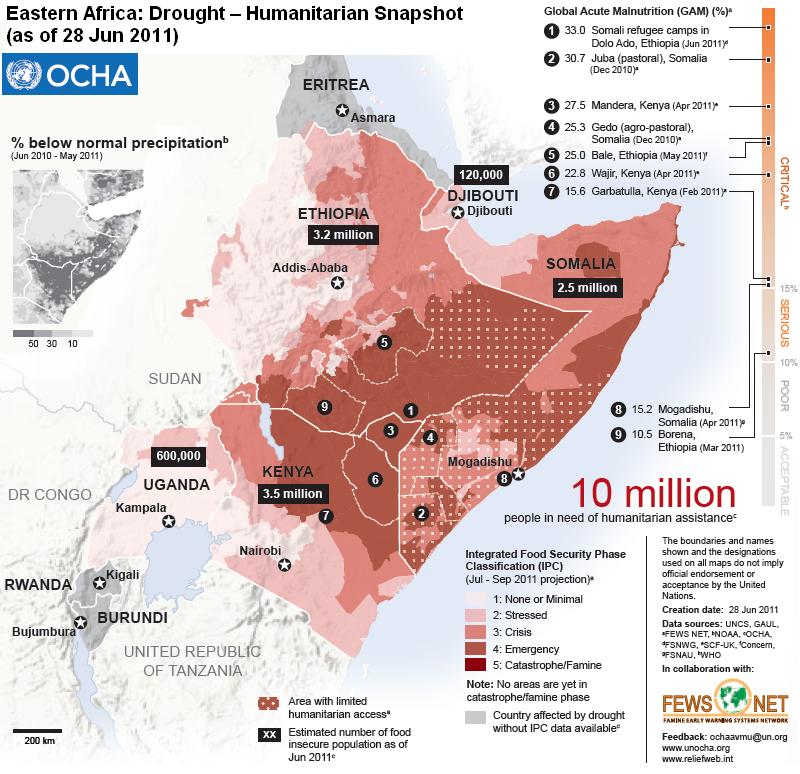
I bet you live in another planet if by now you haven’t encountered the spine chilling portraits of desperate children besieged by starvation and engulfed in squalor; portraits of desperate men and women consumed by pangs of hunger and devastated by the loss of their livelihoods in the horn of Africa, so unequivocally highlighted by international media in the past few days.


I dare say:
This is no news at all, save for the careless reporting by international media hell bent to portray the image of destitution when it comes to matters of the African continent. This is by no means meant to imply that things are rosy and all is well, because it’s definitely NOT. I insist it’s not news watching malnourished children clasping their hungry mothers, desperately suckling nothing. Its not news watching extensive landscapes littered with bones and decomposing tissues of what was once a people’s source of livelihood. Its not news watching the burial of scores of people driven to their deaths by hunger and hearing of children dying every six minutes in refugee camps in Kenya. IT IS INDEED NOT NEWS BECAUSE THIS ISN’T THE FIRST WE WITNESSING THIS, IT’S CERTAINLY NOT THE SECOND TIME, NOT THE TENTH TIME AND I BET IT WON’T BE THE LAST TIME.
                                                             
But what troubles me most is not the careless coverage of the unfolding events in the horn of Africa, but the bee hive of humanitarian activity that has erupted there. Now NGOs, Aid agencies, and International Organizations have swung to action, running around like headless chicken acting as though the drought situation in the horn of Africa is some 7.6 magnitude earthquake that happened overnight and caught everyone flat footed. It is a shame how for decades people wait until human beings of equal right to life succumb to the most painful and horrifying experience - death out of starvation. How people wait until traumatizing images and stories of fellow humans condemned to death by starvation are aired on television to turn on the guilt and ask for charity. It’s a pity how the most basic of all human rights, as been reduced and subjected to charity and to the discretion of individuals, governments and international institutions alike who feel sufficiently philanthropic to give.


I am reading a New York Times article by Greg Jayne’s on November 5th 1980 and this is the headline – ‘Drought Famine and the Spectre of Disease Haunt Crisis Hit Horn of Africa’. What’s annoying though not shocking to me is the endless trail of such headlines in the history of the 20th century. These droughts and famines have been there, humanitarian aid perennially sought (and indeed availed though never adequate as well) yet there is little to show of progress in dealing with them more resolutely. Just a random Google search for – drought in the horn of Africa - reveals thousands of articles, news items, and commentaries of an endless plague that is seemingly not about to go away: It just shows how we have characteristically ‘kicked the can down the road’, wishing it would disappear only to catch up with it down this same road that is humanity!

1975 – Drought claims the lives of more than 40, 000 people and leaves over 800, 000 destitute in Somalia and Ethiopia alone
1980 – Over 2 million refugees affected by drought in horn of Africa
1983 - Ethiopian capital reports that current drought could be as bad as the one a decade ago which killed between 200000 - 300000 Ethiopians
1985 – Somalia’s interior minister Ahmed Suleiman Abdullah says 60% of Somalis about 4 million affected by a serious drought
1987/8 – Relief workers indicate that as many as 7 million face the prospects of famine that could rival the calamities of 1984/85
1991 – Sept 10th UN pleads for USD $400, million worth of aid to help over 22 million hit by drought and civil war in the horn of Africa
1996 - Worsening drought across Somalia forces over 800,000 nomads from the Sol and Sanaag regions to areas bordering Ethiopia. An estimated 500,000 heard of livestock dead
2000 - Jun 1st FAO launches an appeal for $32.6 million to bring urgently needed help to millions of farmers and their families in Ethiopia, Eritrea, Kenya, Somalia and Djibouti suffering from drought and starvation
2006 27th June – top United Nations relief official responsible for KenyaEthiopia, Eritrea, Somalia and Djibouti calls on authorities in the countries to do more to deal with future droughts. Despite recent rains in the region, millions still in need of international assistance – crisis not over
2008 - Jun 29th - Drought in the Horn of Africa is deepening after the failure of annual rains, and the UN estimates that more than 14.5 million people are in need of humanitarian assistance.

I dare say:
For as long as the bankruptcy of political commitment (national, regional and global) for early action, and for the pursuit of sustainable solutions persists, its just a matter of time and we’ll be buying newspapers and glued to our television sets grieving about the deaths of hunger stricken people and calling for more ‘swift action’. For as long as we allow governments to continue setting up myopic assistance operations (food for work programmes and social safety nets) instead of lasting food security mechanisms that divorce the horn of Africa from dependence on rain-fed agriculture and pastoralism reliant on natural precipitation, then sorry to say, but my brothers and sisters in Djibouti, Ethiopia, Kenya and Somalia had better brace themselves for the glaring mean face of famine.  I honestly fail to understand and appreciate the relevance this organization known as the Intergovernmental Authority on Drought & Development (IGAD) when millions of people continue to suffer three decades after its formation. Without consistent and continued pressure on the governments in Eastern Africa to be more responsible and accountable to their people, they will continue to see the droughts as natural disasters that should be copped with. Am confident the situation would not be as dire as it looks currently if the Kenyan government for instance invested in a proper transport system connecting the rest of the country with the perennially marginalised north-eastern regions. It would be much easier for Somalis to import food, and even liquidate their animals with knowledge of eminent drought to avoid loss of livelihoods.

Frankly, famine is inevitable in the horn of Africa for as long as the international community continues to settle for the quick fix – supplying food and other forms of humanitarian aid and failing to increase development assistance for long term projects that address the underlying structural issues that make the drought situation in the horn of Africa more dire. It is clear as eloquently highlighted in the World Disasters Report 2009 that decades of large scale food aid has done very little to prevent the death and deterioration of livelihoods of people in the horn of Africa. What’s even more appalling is the knowledge that some donors turn down appeals for funding for preventive action yet they make pronounced media conferences yelling out their successes in mobilising and providing emergency response aid. In 2008 for example some donors ignored appeals by CARE to fund the protection of health and assets of vulnerable populations in the Horn of Africa amidst early warnings of eminent crop failure.  


Essentially, what humanitarian aid is succeeding to do is providing a scapegoat and easy lee way for the international community to continue absconding its duty to humanity and to rationalise the prevailing deficiency of appetite and political will to intervene in Somalia – to broker lasting peace and deal with the political mess and mayhem sustained by al shabab and the other warring factions. 


Indeed famine is inevitable in the horn of Africa for as long as international media fail to find time to follow up on donor commitments for sustainable development assistance, monitor progress and keep governments accountable for provision of public goods than excelling in the portrayal of Africa as a continent of pain, squalor suffering and desperation. How I wish they could focus more on highlighting African statesmen and women who have prospered in providing leadership to defeat hunger like Malawian President Mbingu Wa Mutharika and unambiguously underscore best practices – policies and strategies that are succeeding (amidst the odds) in guaranteeing food security and safeguarding the livelihoods of Africans.

It is indeed moral to feel obligated to contribute resources to support action to reduce human suffering: But I find it immoral as well to keep doing what is clearly an impediment to more serous, sustainable action to prevent more death and loss of livelihoods.

Kicking the can down the road certainly won’t sort out the famine problem. Ultimately, we will find the can down the road somewhere when it looses the momentum to continue rolling. Aid agencies will get fatigued, donations will get depleted, more disasters will occur elsewhere, and more 'news worthy events’ will certainly erupt (isn’t it disturbing how the Murdoch antics have overshadowed and deflected attention from this disaster?).

Well, 55 years ago when it was apparent to Egyptians that they definitely had no sustainable source of water, and they understood the implications of this on the survival of their nationhood – Abdul Nasser led the engineering of a sustainable solution to what was clearly a threat to his people. Though tough decisions had to be made (the nationalisation of the Suez Canal Company), wars fought, colossal amounts of resources expended and international relations severed, the Aswan High Dam was built. This guaranteed the future of Egypt, it guaranteed a sustainable source of fresh clean water and insured Egyptians against famine and starvation. Such is what I see as ‘resolute handling of the can’ and not a ‘shameless kick down the road’


Sunday, 5 June 2011


Freed too early or simply refused to grow up???

Well, this was my facebook update at 4:00 am GMT Wednesday 1st June 2011 – ‘i still love you my mama land, Happy Madaraka Day Kenya’. As I posted that update, I was in deep thought, reflecting on the trajectories of a country that was in celebration counting down forty eight years since liberation from the paws of colonial tyranny and exploitation. I was thinking about Kenya because it was Madaraka Day, 2011. I remembered my primary school history teacher explaining to us the importance of this day so diligently with unmeasured enthusiasm. The day of our heroes, this day that we were meant to commemorate the courage and determination with which our fore fathers resolved and fought to liberate our country, to set us free of the yokes of imperialism and to chat the path for our self determination as a sovereign people, a people apt to lead, govern, protect, feed and prosper themselves. 
And I could not help but imagine threads of similar stories being narrated in a vast majority of African countries; about 50 years ago a wave hit the African continent, a surge in the courage and determination akin to that of my Kenyan fathers. From Abdel Nassser in Egypt to Philibert Tsirana in Madagascar; from Thomas Sankara in Burkina Faso to Mwalimu Julius Nyere in Tanzania; Patrice Lumumba in the DRC to Kenneth Kaunda in Zambia,  the common denominator was the confidence in the maturity of the African Continent to rule herself; the thirst for ‘madaraka’- autonomy and sovereignty. Well, those wishes were granted, nations were born, governments were formed, and leaders installed but how much have our fortunes changed? Have we reaped the fruits of the struggle? Can we look back and say we have lived the dreams of our fathers? How far are we from Canaan – the Promised Land? What’s ailing us?


In my attempt to make sense of these questions, I pondered on what half a century of self rule has yielded, what dividends the African common citizen has accrued from the struggle and i wondered whether there was anything worth the fanfare and celebration. So I likened the phenomenon of nationalism in Kenya to a ‘young African man’ who comes of age, convinced of his aptitude to take care of himself – to live independent of his parents (or fosters). According to the Luo traditional culture, once a young man left his father’s compound, it signified maturity, and he went out to build himself a new home, together with his wife(ves) and children. He assumed the responsibility of providing shelter, food, protection, income and most importantly leadership to his new family. I used this analogy to understand what value the quest for soverinity and self rule has added to the lives of ordinary citizens.


I began with the ‘young man’s’ duty  to guarantee the safety of his family, protect them from danger, and safeguard family property. Well this forty eight year old nation is still fumbling with border security issues; issues that have seen many Kenyans lose their lives in the North-eastern counties, many lose their property to cross border rustlers and many harassed by Ugandan authorities in Lake Victoria. This nation watches as her citizens are slaughtered by Ethiopian insurgents and watches as her young men are recruited into extremist, terrorist groups like the Alshabab in Somalia. This nation’s grip on internal security is still wanting allowing crime levels to escalate and threaten the very lives, property and sovereignty that it sought to safeguard. This nation that has allowed governments to turn against its own people with brutality and extrajudicial force - the Wagalla Massacre, the aftermath of the election 2007, the execution of young men in the name of Mungiki, the list is extensive. Stanza one of this nation’s anthem states – ‘may we dwell in unity, peace and liberty’. I wonder how much sense this makes to the generation of young men and women with little knowledge and appreciation of the nationalism movement 50 years ago, when today they live in constant fear of violence, surrounded by mayhem and protracted ethnocentric political squabbles.


Still using that analogy of the African young man, this young man – ‘the Kenya nation’ has failed to guarantee the most basic right; that of life and good health. Life expectancy today is at 54 years (sometimes even less other factors considered). Forty eight years and this nation is still struggling with food security, people still die of hunger and starvation, government after government continue to declare droughts as national disasters. Forty eight years yet this nation still hasn’t figured out how to make the best use of our Arid and Semi Arid Lands when lots of countries like Israel and other squarely located on deserts export fruits. This nation still depends on rain fed agriculture to feed her people. This nation has let her people battle high inflation rates surviving on per capita incomes of low as $718.


In my analogy, the initial assignment of the young man was to establish a home (shelter for his new family) that he would regularly repair and maintain to ensure the family had dignity and privacy, was protected from environmental hazards and had somewhere they called home. Now it’s appalling to even imagine that forty eight years down, Kenyans, citizens of this ‘nation’ still live in limbo, landless, squatters engulfed in squalor and despair yet the issue of land was the epicentre of the nationalism movement. Isn’t it shameful that a small bunch of greedy feudalistic individuals who hijacked the process of building this nation continue to hold on with hardened hearts to lands they don’t make optimal economic use of while many deserving Kenyans crave for just a square they can call home? Isn’t it shameful that over 45% of this nations urban population continues to squat in horrendous informal settlements under deplorable conditions? Isn’t it shameful that thousands of citizens of this nation still live in tents and make shift camps as (internally displaced persons) refugees in their own country? I look at this and wonder what splendour could possibly reside in such a heritage (as proclaimed in the national anthem), I wonder then how the label ‘Kenyan’ profits such masses of deprived people.


The last duty that the young man was socialised to discharge was that of providing leadership, making crucial family decisions, presiding over important occasions like the opening of the planting season or harvesting, presiding over marriage negotiations for siblings and conflict resolution. This is what a likened to leadership and governance in the context of this ‘nation’. I presumed that the fathers of this nation must have dreamt of a just society, freed of colonial oppression, a society of equal opportunity, liberty and self determination in their quest for ‘madaraka’. Well, the white man left (may be still lingering around or exerting influence by proxy) and for forty eight years successive governments have displayed their ‘art’ of self rule. This nation has showcased her knack at kleptocracy, impunity, disregard for the rule of law; lopsided justice systems, rogue legislature, inept bureaucracy and bungled elections have been the hall mark of ‘this nation.


In Wars, Guns and Votes, Paul Collier posits that nation building is not a mere exercise of establishing institutions. It must involve an ordered and careful nurturing of a sense of ‘identity’ that the political regimes must work together to purposefully inculcate. I wonder how well this nation has prospered in moulding this sense of ‘identity’. It may pass as unpopular discourse, but when citizens of a nation repeatedly express their feeling of alienation, someone should be worried. I have heard on several occasions, Kenyans residing in the North Eastern counties casually ask people travelling from Wajir, Garrissa, Mandera etc to Nairobi to say hi to Kenyans. The impression is that they exist in a region, county or locality distinct and disparate from the Kenyan nation. It’s obvious that such sentiments emerge from a gradually building bankruptcy of identity with the Kenyan nation. This is dangerous breeding ground for regional, ethnic or religious revolt; rebel factions (with civil war-like implications) in many parts of the African continent have mushroomed from such loosely expressed sentiments that unfortunately fall on deaf ears. The Mombasa Republican Council is expressing congruent sentiments, albeit more explicitly and aggressively. The government can opt to use state force and military might to arm twist them, but would that address the continuing exfoliation of national identity - this crucial ingredient of nationhood? The truth is, the ‘Kenyan Nation’ is slowly loosing currency and is in dire need of rejuvenation or re-engineering.


When all is said and done, the three enemies of the Kenyan nation - hunger ignorance and disease so well articulated by the fathers of our nation back in 1963 are still with us. In fact even more have sprung up, those which Dambisa Moyo in Dead Aid refers to as the ‘four horsemen of the African apocalypse’, that continue to threaten the existence of this nation. Where did we err? Were the fathers of this nation a little too hasty and haphazard in the process of nation building? Or is it that the citizens have abdicated their duty to themselves and to this nation? Is it that the ‘young man’ was let free a little too early (prematurely) or did he just refuse to grow up once he crossed over to the new home (madaraka)? How could we possibly hasten the rebirth of this nation? Does the new constitutional dispensation posses the muscle, does it ignite the will power and does it provide the much needed platform upon which a just, prosperous, unified and peaceful nation could be reengineered?

Thursday, 26 May 2011


‘Expert Analyses’

Well my typical day begins at 4am with  an almost ritualistic skim through youtube and news sites like Kenya Moja.com for internet postings of the previous day’s headline because from the remote niche on planet earth that I exist, am not privileged to receive real time Kenyan news. However my dawn-time routine today treated me to a rather startling revelation that has occupied my mind for a better part of the day and is the reason I squeezed in some time to do this post. 

What stunned me is the way it’s almost become standard practice today that media houses accompany ‘important’ news items with ‘expert opinion’ or 'commentaries' or 'analyst views' of questionable credibility. It’s the way today news bulletins are full of unfounded analyst reviews and wild claims about the future that frequently go unquestioned. Pundits and analysts alike make erroneous claims and tenuous predictions and seldom get called on.  Whether it’s a nuclear mishap in Japan, the ICC proceedings, EU bailout plans for Portugal and Ireland, state brutality in Syria, some celebrity scandal or a rogue politician on the streets of Nairobi, media houses run amok like headless chicken seeking expert opinion for whatever reason I still fail to fathom.

I don’t claim even implicitly that it is wrong to enrich news items with informative expert expositions, analyses or even predictions, but if no one is going to take time to scrutinise the aptitude of these experts to give constructive counsel on matters of significant gravity like the demeanour of government officers or the constitution or the volatile political climate in our country and if no one is prepared to spare time to track the coherence of such assertions, then I’d rather  our media stuck to reporting and recounting events as they happen and let the public  munch and synthesise for themselves. Some of those interviews come across as though they are just ornamental aesthetics purposed to paint the image of a matured industry yet content and objectives of their employment are inadequately considered.  

Research has shown that persons exposed to newscasters, commentators, analysts or whatever name you choose to call them increase their knowledge of what is reported when it is factual. However, it also cautions that an analyst’s position or prediction fundamentally alters the opinions of the audience in the direction of the prediction and where erroneous predictions or insufficiently thought through discourse is transmitted to the public; the outcome shouldn’t be too hard to imagine. A study conducted to establish the impact of post presidential debate analysis in the USA on public assessment of the winner or loser in 2004 concluded that such analyses profoundly altered the judgement of the public at least in the short run. The manner in which the analyses were presented, the conduct of the commentators and the content of their discourse all functioned either to buttress presuppositions or sway opinions altogether.

So I sat there pensively in front of my laptop wondering just how much twaddle and claptrap has been peddled around by Kenyan media in the name of ‘expert opinions’.  How much does the public trust and believe them and how far-reaching are the impacts of such commentaries on public opinion and civic attitude? Who questions the objectivity of such analyses? Who critiques the contents of their discourse? Who takes responsibility for the plethora of misleading assertions served to the public by such ‘experts’?

Well, I might be wrong, or may be am just overreacting. Is there anyone out there with a congruent opinion as I?

One thing that development experience has taught me is never to open my mouth making wild claims without proof. So I sought to share with you just a tad bit what I mean when I talk of erroneous assertions and analyses. I randomly chose one Mutahi Ngunyi, political scientist, consultant, columnist name it (may be because he’s one of the most vocal and sought after political analysts in Kenya today). It’s amazing what a skim through the past can reveal. While he has made some predictions that have come to pass, some of his judgements are equally flawed and deficient of basis.

Skim through these links to see just how incoherent one man’s opinion on similar and interrelated issues can be so inconsistent over time yet seemingly ignored or simply unnoticed by the same media houses or journalists who run to him day after another.


http://tinyurl.com/3jln3zv  - scroll to 03:23
http://tinyurl.com/3oswong - scroll to 00:28
http://tinyurl.com/3dcpyjd - scroll to 01:38
http://tinyurl.com/3tnnysb  – scroll this down to 01:26 – 2:34
http://tinyurl.com/3vudvnj  – scroll this to 00:50
http://tinyurl.com/3dl8ta2

http://tinyurl.com/4y7wk2k  

http://tinyurl.com/3vr4fx6  scroll to 00:38 

http://tinyurl.com/3req3tg